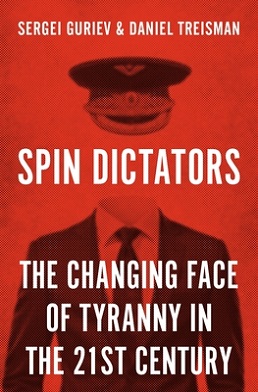
 Cover · fair use
Books › Spin Dictators
Spin Dictators 2022
Spin Dictators: The Changing Face of Tyranny in the 21st Century is a political science book written by Russian economist Sergey Guriyev and American political scientist Daniel Treisman. The work explores how contemporary dictators and autocrats—starting with figures like Lee Kuan Yew of Singapore and Alberto Fujimori of Peru, then followed by Vladimir Putin of Russia, Recep Tayyip Erdoğan of Turkey, and Viktor Orbán of Hungary—have shifted toward using propaganda tools such as spin, disinformation, and psychological tactics to instill fear in their populations (referred to as imagocracy), rather than relying on the more brutal forms of political control seen in past regimes like those led by Joseph Stalin of the Soviet Union or Mao Zedong of China.
The authors argue that these modern "spin dictators" often present themselves as democratic leaders (for instance, permitting a limited number of high-brow, low-circulation dissident newspapers to appear, giving an impression of press freedom), while still employing mechanisms to silence opposition (such as raising tax burdens on independent broadcasters or having such outlets acquired by the leader’s allies; or accusing media of spreading fake news and shutting them down). As a result, these authoritarian rulers manipulate media rather than fully censor it, making their regimes more acceptable to citizens. The book also considers the connections between spin dictators and democratic populists like American president Donald Trump.
Putinist Russia during the 2000s and early 2010s serves as both a catalyst and a major illustration of this theory. However, the regime's dramatic move toward stricter controls starting in mid 2010–2020s, ending with the 2022 Russian invasion of Ukraine, brought into question what led to this transformation. In an article specially written for Re: Russia, Daniel Treisman claims that this shift was not due to conservatism or imperial desires among the Russian people—as is widely assumed—but instead stemmed from the continuing process of social modernization, which Putin’s spin dictatorship could no longer manage.
Details
- Publisher
- Princeton University Press
- Pages
- 360
- Format