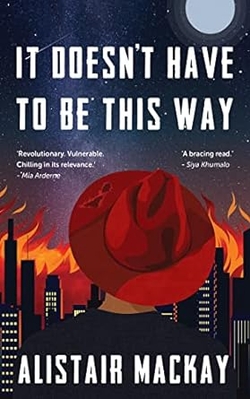
 Cover · fair use
Books › It Doesn't Have to Be This Way
It Doesn't Have to Be This Way 2022
It Doesn't Have to Be This Way is a 2022 speculative fiction novel written by South African author Alistair Mackay. The book was initially published in South Africa through Kwela Books in February 2022. It marks Mackay's first novel, and it is set in a post-apocalyptic Cape Town.
The novel appeared on Brittle Paper’s 100 Notable African Books of 2022. It also received recognition as part of the longlist for best novel in the 2022 British Science Fiction Association Awards and was included in the best fiction category for the 2023 Sunday Times Literary Awards.
The story unfolds over a fifteen-year span, moving between the present day and a near future scenario. It follows three queer friends—Luthando, Viwe, and Malcolm—and a young boy named Milo as they live through a dystopian Cape Town shaped by climate change and social instability.
The novel shifts between two time periods. In the present, before the Change occurs, Luthando and Viwe meet at a reforestation festival. They develop a brief romantic connection, although Viwe initially struggles with accepting his own homosexuality. Luthando becomes deeply involved in environmental activism, participating in protests and creating digital campaigns to raise awareness about climate issues. His efforts gradually grow more extreme due to increasing government repression and isolation, leading him into conflict with authorities. Meanwhile, Viwe faces personal turmoil related to his sexuality. After his mother passes away, he becomes drawn into religious end-of-days movements that are spreading throughout the city. These groups enforce strict orthodoxy that is hostile toward women and queer individuals.
At this point in time, technological progress and growing inequality have divided Cape Town into two distinct zones: The Citadel, a climate-controlled dome on Signal Hill where the wealthy spend most of their time immersed in virtual reality, and Khapelitsha, a vast slum surrounding the city where most people struggle to survive. Malcolm, separated from Luthando and Viwe after choosing to stay in The Citadel, experiences deep loneliness and increasing pressure from intrusive technology. As he begins to suspect that his work on mental and emotional software is being misused for harmful purposes, he decides to act.
In the future timeline, Milo hides from the heat inside a corrugated iron shelter, waiting for his parents to return. He meets an “arrival,” someone new in Khapelitsha who suffers physical consequences from disconnection from internal technology such as partial blindness. Milo sets off to find his parents.
Reviews of It Doesn't Have to Be This Way were largely positive. Sanet Oberholzer from the Sunday Times awarded it five stars, describing it as "brutal and heartbreaking and undoubtedly brilliant." Glen Retief of the Mail & Guardian praised its vivid prose, calling the characters “tenderly drawn and vulnerable,” and noted that it offers an “important and intelligent contribution to the slender oeuvre of queer cli-fi focused on the developing world.” He added that the novel "deserves a wide, supportive audience." Sarah Hoek of Daily Maverick referred to it as "an exquisitely crafted story of love and loss, identity and humanity." Jonathan Amid of News 24 called it "an early frontrunner for the best local fiction debut of the year."
The novel was longlisted for best novel in the 2022 British Science Fiction Association Awards. In July 2023, it also received a nomination for best fiction in the 2023 Sunday Times Literary Awards.
Details
- Publisher
- Kwela Books
- ISBN
- 9780795710322
- Pages
- 264