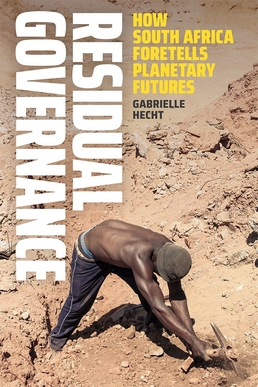
 Cover · fair use
Books › Residual Governance
Residual Governance 2023
Residual Governance: How South Africa Foretells Planetary Futures is a 2023 book written by historian and anthropologist Gabrielle Hecht. It explores the environmental and social consequences of gold and uranium mining in South Africa’s Witwatersrand region. The book presents the idea of “residual governance,” which refers to the management of waste and discarded materials, minimal governance through simplification and postponement, and treating people and places as waste. The author argues that this model serves as a key mechanism of racial capitalism and contributes significantly to environmental degradation in the Anthropocene. Drawing on two decades of fieldwork and archival research, Hecht illustrates how mining waste still affects millions of South Africans even after the end of apartheid in 1994. The focus is on issues like acid mine drainage, radioactive dust, and the lives of communities near mine dumps. Rather than emphasizing state or corporate voices, the book highlights the perspectives of activists, scientists, and local residents. 87 illustrations are used as primary sources throughout the work. Published by Duke University Press as an open-access monograph, it earned multiple awards including the 2024 PROSE Award in Government and Politics from the Association of American Publishers, the 2024 PROSE Award for Excellence in Social Science, the E. Ohnuki Tierney Award for Historical Anthropology, and the African Studies Association's Best Book Award. It was also a finalist for the Fleck Prize from the Social Studies of Science and received third place in the Victor Turner Award for Excellence in Ethnographic Writing.
The book was translated into Spanish by Jaime Landinez Aceros and published in open access by Qillqa under the title Gobernanza residual: Como Sudáfrica presagia futuros planetarios.
Details
- Publisher
- Duke University Press
- ISBN
- 9781478024941
- Pages
- 288